![Andrea Venzon [English]](https://substackcdn.com/image/fetch/$s_!_TTE!,w_120,h_120,c_fill,f_webp,q_auto:good,fl_progressive:steep/https%3A%2F%2Fsubstack-post-media.s3.amazonaws.com%2Fpublic%2Fimages%2Facd73441-dd62-4692-b623-54f4cf7c2bb7_1231x1231.png)
We Need an Avantgarde to Defend the Future.
Do You Want to Be Part of It?

There is a belief that is imposing itself, silent and fast, before anyone has time to object. The future - they say - belongs to the most efficient systems. To the most precise algorithms. To the most powerful oligarchs. To the most ruthless investors. And anyone who wants to slow this process down, anyone who dares ask who controls these machines and in whose interest, gets dismissed as a reactionary, a nostalgic, an obstacle to progress.
I am here to flip that narrative.
Whoever defends human sovereignty over artificial intelligence is not a conservative, not a luddite. They are the avantgarde.
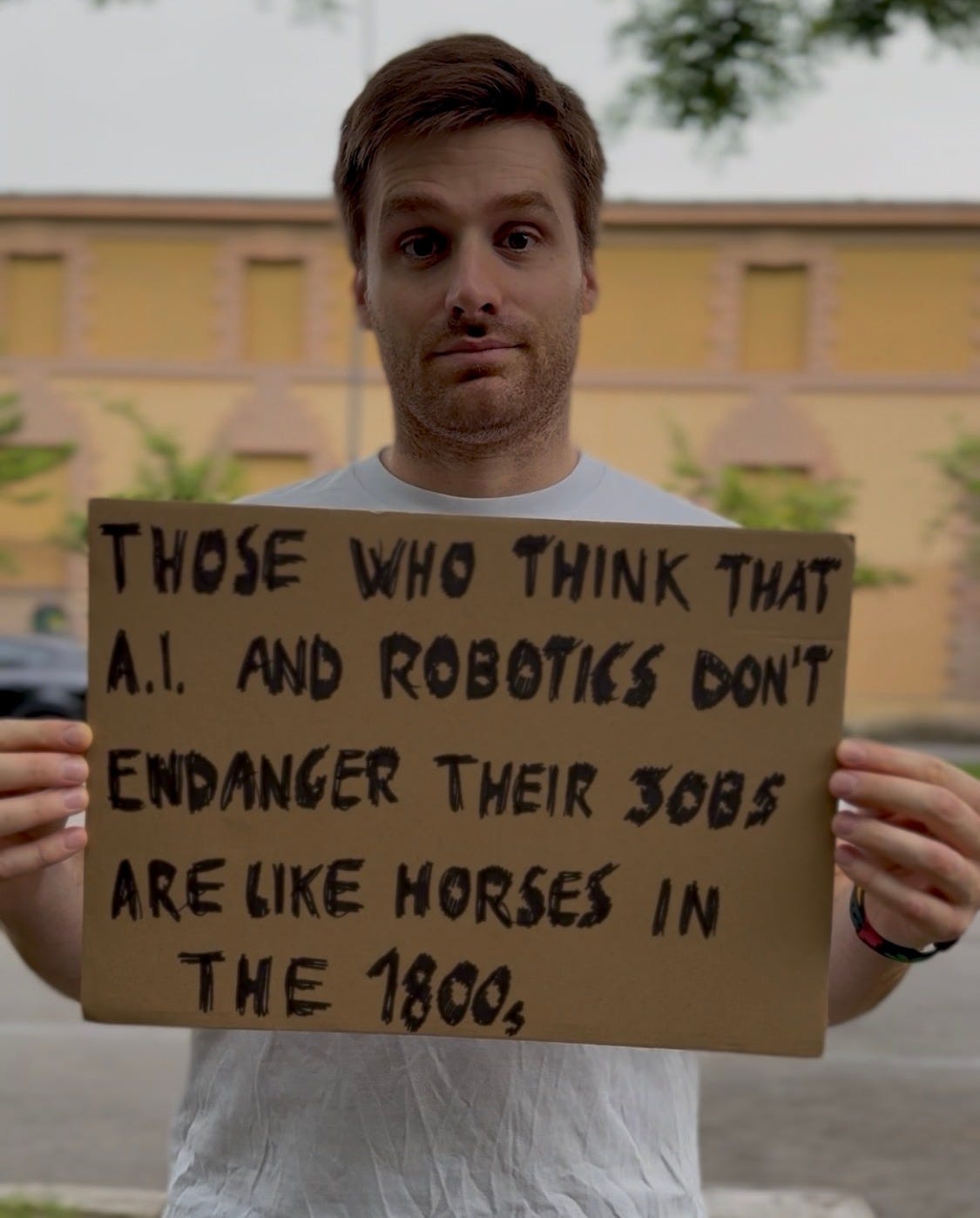
My name is Andrea Venzon. I founded Volt Europa, the first transnational party in European history, today represented in several national parliaments and the European Parliament. I built the Atlas Movement, a global progressive network active in 130 countries with 25,000 members. I have worked on political and institutional strategy for more than a decade, from Brussels to Nairobi, from London to New York.
I have seen up close how the big decisions that reshape the world get made: far from public debate, in rooms where few people sit, without democratic mandate, often without even an awareness of the consequences. With artificial intelligence, this process has accelerated at an unprecedented pace.
Let’s be clear. Over the past few years, one of the greatest transfers of power in modern history has taken place. Not through elections, not through treaties, not through revolutions. Through server farms, language models, and commercial agreements signed in silence.
A handful of companies - almost all American, some Chinese - is building the systems that will soon decide who gets a mortgage, who passes a job interview, who ends up under surveillance, how information spreads, how wars are fought. These systems are not neutral. They embed values, priorities, interests. But no one voted for them.
Meanwhile, governments are struggling to keep up. Europe produced the AI Act - a serious but imperfect effort, already under pressure. The United States dismantled the modest regulatory attempts of the previous administration. The Global South, which will bear the heaviest consequences of this transition, has almost no say.
The window is closing. And most people don’t even know it was open. This publication exists to do one simple thing: keep that window open for as long as possible.
This is not a technical outlet. You will not find code analysis or model benchmarks here. What you will find is a political argument: that human sovereignty over artificial intelligence is worth the cost of defending it. That the trade-off between efficiency and democratic control is real, and that choosing democratic control is not a mistake - it is the only rational choice for anyone who wants to live in a free society.
You will also find a broader ambition: these ideas are not meant to stay on paper. The goal is for them to translate, over time, into a concrete political offer. How and when, we will figure out together.
Why now?
Because in a year’s time, the most important choices will already have been made.
The implementation of the European AI Act - the most ambitious regulation on AI governance in the world - is already being overtaken by events. The collapse of regulatory oversight in the United States is creating a vacuum that someone will fill. Elections across Europe are reshaping who sits at the tables where these decisions get made.
Whoever is not at that table does not decide. They are on the menu.
I expect some people to bristle at this publication. Those convinced that technological efficiency is a value in itself. Those who think politics cannot - and should not - engage with complex systems. Those comfortable with the idea that the future should be designed by engineers, not citizens. And those who think there are more urgent problems - when this is the single factor that will determine the concentration of power and wealth more than any other in the years ahead.
I respect these positions. I will fight them.
Because if there is one lesson I have learned building transnational political infrastructure, it is this: the rules of the game do not change on their own. They change when someone decides to change them - with organisation, with arguments, and with the patience of someone who knows that important battles are not won in a news cycle.
Over the coming months I will write about AI governance, economic power and technological concentration, how to build a transnational political movement in 2026, and what defending democracy means today. Each article will be one piece of a larger argument.
If this vision interests you, subscribe. If you know someone who should read it, share it.
And if you have objections - if you think I am wrong, that the problem is framed badly, that there are angles I am not seeing - write it in the comments. This space is built for that too.
The future is not written. Let’s write it now.