![Andrea Venzon [English]](https://substackcdn.com/image/fetch/$s_!_TTE!,w_120,h_120,c_fill,f_webp,q_auto:good,fl_progressive:steep/https%3A%2F%2Fsubstack-post-media.s3.amazonaws.com%2Fpublic%2Fimages%2Facd73441-dd62-4692-b623-54f4cf7c2bb7_1231x1231.png)
We Are Educating Our Children for a World That No Longer Exists
If AI takes our jobs, children must be trained for purpose

There is a question that most education systems have not yet seriously asked, even though the answer will define the lives of every child currently sitting in a classroom: if AI is taking most jobs away, what exactly are we preparing them for?
The question is not hypothetical. The previous piece in this series made the case that AI-driven displacement is already underway, that it will accelerate, and that the optimistic assumption - new jobs will emerge to replace the old ones - may not hold in an era where artificial intelligence is advancing across every cognitive domain simultaneously. If that is even partially right, then the implicit contract at the heart of modern education - study hard, get qualified, find employment, build a life - is being quietly voided, and the institutions responsible for preparing the next generation have not begun to reckon with it.
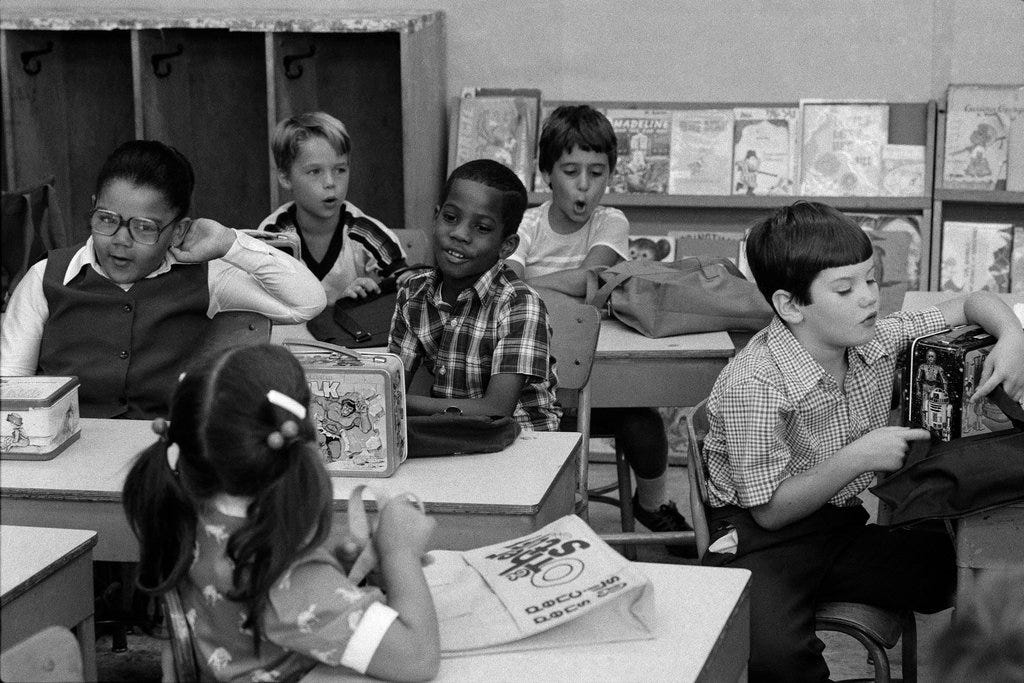
Most education systems around the world were designed, in their current form, during the industrial era and refined during the postwar economic boom. Their architecture reflects the needs of that moment: standardised curricula, age-grouped cohorts, examinations that measure the retention and application of established knowledge, credentials that signal employability to prospective employers. The entire system is oriented, at its deepest level, toward producing workers - reliable, credentialed, interchangeable workers for an economy that needed them in vast numbers.
That economy is changing faster than the institutions built to serve it.
The first and most immediate concern is one that tends to get lost in debates about AI and education, which focus almost entirely on how AI can be used as a teaching tool: the risk that growing up with AI assistance actively degrades the cognitive capabilities that make us human.
This is not technophobia. It is a straightforward observation about how skills develop. The capacity for sustained concentration, for working through a difficult problem without reaching immediately for external assistance, for holding an argument in one’s head long enough to test it against counterarguments - these are not innate gifts but trained capacities, developed through practice and atrophied through disuse. A generation that grows up outsourcing its thinking to AI systems from an early age will develop differently than one that was required to struggle with complexity unaided - and not, I would argue, in ways that are straightforwardly positive.
The analogy with physical capability is imperfect but instructive. We do not stop teaching children to walk because cars exist, or stop encouraging exercise because physical labour has been largely automated. We recognise that the capability has value beyond its immediate instrumental use - that a body which moves is healthier, more resilient, more fully alive than one that does not. The same logic applies to minds. The fact that AI can write your essay, solve your equation, or construct your argument does not mean that learning to do these things yourself has become pointless. It may mean, if anything, that it has become more important - because the capacity for independent thought is precisely what will distinguish humans from the systems we have built, and what will allow us to govern those systems rather than simply deferring to them.
This is an argument for doubling down on the fundamentally human dimensions of education - reading difficult texts, writing with precision and care, learning to reason through problems rather than around them, developing the kind of broad cultural and historical literacy that allows you to situate new developments in a longer frame. Not despite AI, but because of it.
The second challenge is deeper and more structural: what is education actually for, if not primarily for employment?
This is, in one sense, a very old question - philosophers have been arguing about the purpose of education since Plato - but it acquires new urgency in a context where the employment rationale, which has dominated educational thinking for at least a century, can no longer be taken for granted. If we cannot promise children that their qualifications will translate reliably into livelihoods, then the honest answer to “why should I study?” requires a different foundation.
The answer, I think, is that education should be reconceived as the project of becoming a more fully developed human being - not in the vague, motivational-poster sense, but in a specific and serious one. It means developing the capacity to think clearly and independently. It means cultivating genuine curiosity about the world and the intellectual tools to pursue it. It means learning to live with others, to navigate disagreement, to contribute to collective life in ways that go beyond economic productivity. And it means discovering what you actually care about - not what the labour market values, but what gives your particular existence meaning and direction.
In a world where AI handles an increasing share of instrumental tasks, the things that remain distinctly and irreducibly human - the capacity for genuine relationship, for ethical judgment, for creative expression that is rooted in lived experience, for political agency - become more rather than less important. An education system oriented toward these things would look quite different from one oriented toward employability, and the transition will not be simple or painless. But it is the direction that intellectual honesty about where we are headed should push us.
The third challenge is the most politically sensitive: how do we prepare children concretely for the possibility of a world in which stable, lifelong employment is not available to them - without either lying to them about the prospects or abandoning them to despair?
Part of the answer lies in the policy arguments made in the previous piece: an AI Transition Fund, income support, ultimately perhaps universal basic income, so that a life without conventional employment does not mean a life of poverty and insecurity. But part of it also lies in education itself - in teaching young people to think about work differently, to understand the difference between employment and meaningful activity, to develop the practical and creative capacities that allow a person to build something worthwhile even outside the formal structures of the job market.
This is not an argument for lowering ambition. It is an argument for redirecting it. The children sitting in classrooms today will live through the most consequential technological transition in human history, and they deserve an education honest enough to acknowledge that, and ambitious enough to prepare them for it - not just as workers, but as people.
What would this actually look like in practice? The philosophical reorientation is necessary, but it needs to be translated into concrete policy choices - and some of them are not as distant or radical as they might seem.
The most immediate is a restriction on AI tool usage in foundational education. Just as calculators were long excluded from early mathematics education on the grounds that children need to develop numerical intuition before they can use tools to extend it, AI assistants should be kept out of the stages of learning where core cognitive capacities are being formed - writing, reading comprehension, basic reasoning, problem-solving. This is not about being anti-technology; it is about sequencing. You build the capability first, then you augment it. Doing it the other way around produces neither good thinkers nor good AI users.
Beyond that, curricula need to be substantially redesigned around what might be called durable human competencies: critical thinking and the ability to evaluate sources and arguments; ethical reasoning and the capacity to navigate complex trade-offs; creative and collaborative skills that are genuinely difficult to automate; emotional intelligence and the interpersonal capabilities that underpin both relationships and political life. These are not soft skills to be added at the margins of an otherwise unchanged system - they need to become the core, around which everything else is organised.
Vocational and higher education need an honest reckoning with labour market trajectories. Universities and colleges that continue to sell credentials as reliable tickets to specific careers without acknowledging the degree of uncertainty that now surrounds those projections are not serving their students - they are selling them a story that may not hold. Institutions that take this seriously will redesign their offerings around adaptability and breadth rather than narrow specialisation, and will be transparent with students about the landscape they are entering.
Finally, and perhaps most importantly, schools need to begin teaching young people about the political and economic dimensions of AI itself - not as a technical subject, but as a matter of democratic literacy. A generation that grows up understanding how these systems work, who owns them, how they are regulated, and what is at stake in the choices societies make about them will be far better equipped to participate in those choices than one that treats AI as a given, like weather.
The most important thing we can give the next generation is not a set of skills that AI will render obsolete within a decade. It is the capacity to think, to adapt, to find meaning, and to participate in the political and social decisions that will determine what kind of world AI actually produces.
That is a different educational project from the one most systems are currently pursuing. It is also, I would argue, a more worthy one.