![Andrea Venzon [English]](https://substackcdn.com/image/fetch/$s_!_TTE!,w_120,h_120,c_fill,f_webp,q_auto:good,fl_progressive:steep/https%3A%2F%2Fsubstack-post-media.s3.amazonaws.com%2Fpublic%2Fimages%2Facd73441-dd62-4692-b623-54f4cf7c2bb7_1231x1231.png)
Venezuela Was Promised Freedom. It Got Dependency.

When Nicolás Maduro was kidnapped and removed from power, many cheered.
Some did so out of desperation. Others out of hatred for a regime that had crushed dissent, impoverished millions, and hollowed out a country with extraordinary human and natural wealth. That anger was legitimate. Maduro’s Venezuela was not free, not democratic, not just. Even I - who strongly condemned the horrible imperialistic attitude of Trump and the blatant disrespect for international law - could understand the happiness of Venezuelans at being freed from a dictator.
But many others applauded for a different reason: because the operation was carried out by Trump’s United States. And in today’s broken political debate, that alone was enough to suspend all critical thinking. We were told - loudly, confidently, repeatedly - that this was the moment Venezuela would finally become democratic. That an illegal kidnapping of a sitting head of state was not imperialism, but liberation. That sovereignty no longer mattered, because the end goal was “freedom”.
So let’s ask the only question that matters.
Where is that freedom?
Maduro is gone. But power has not changed hands. The same political class that ruled Venezuela for decades is still there. The same networks, the same elites, the same structures of control. Only now, instead of being hostile to Washington, they are dependent on it.
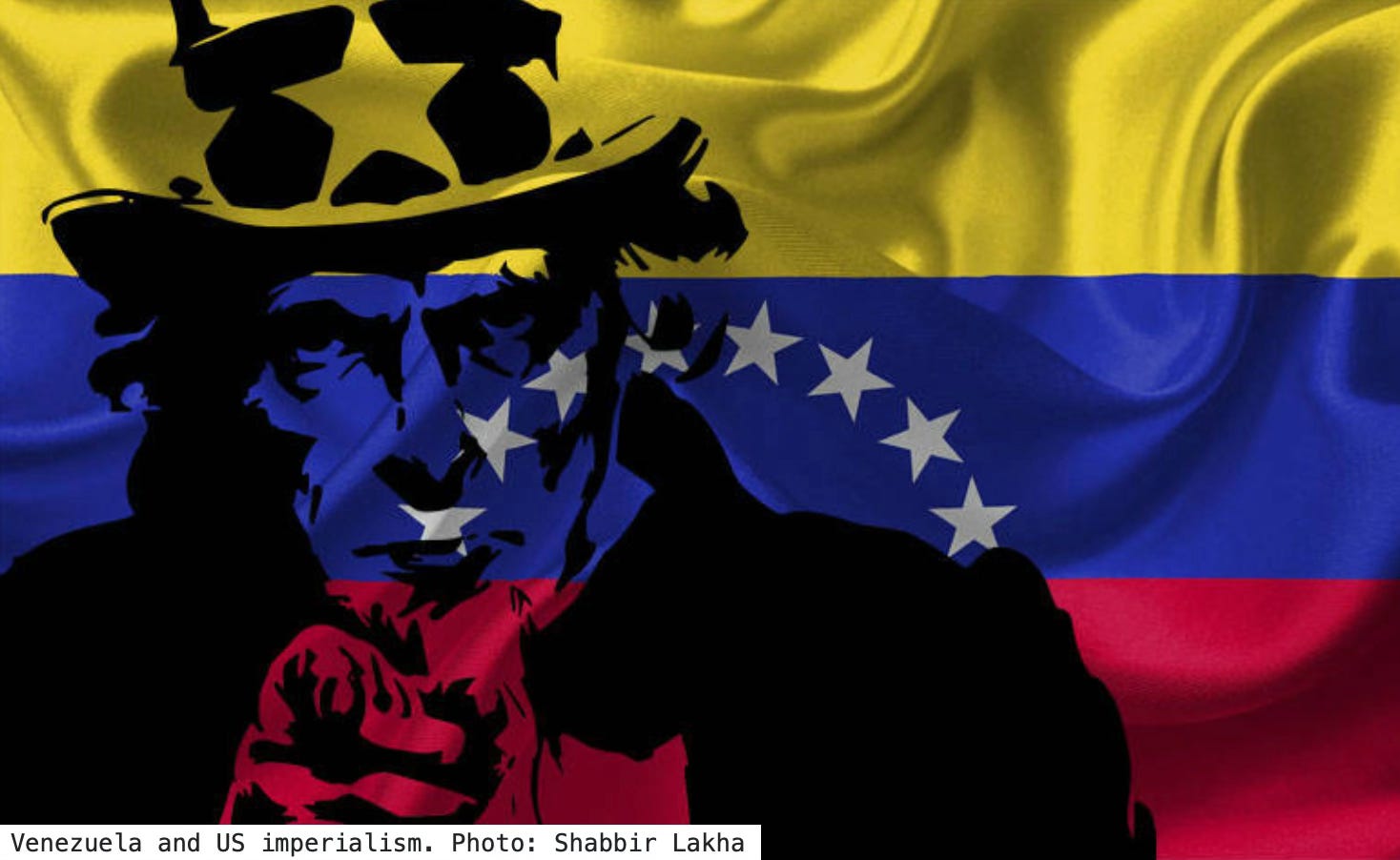
And that dependency is not abstract. Oil - Venezuela’s lifeline, its curse, its historical battlefield - is already being reassigned to American companies. Decisions about extraction, commercialization, and profits are no longer primarily Venezuelan decisions. They are being shaped elsewhere, according to interests that are very familiar to anyone who knows Latin American history.
Local communities? Absent.
Democratic deliberation? Non-existent.
Popular sovereignty? A slogan, not a reality.
So again: is this freedom? Or is it simply another colonial project with better branding?
We have seen this movie before. A dictator falls. The flags change. The rhetoric improves. And yet, real power moves even further away from the people it claims to liberate. Yesterday’s authoritarianism is replaced by today’s tutelage. Yesterday’s repression by today’s dependency. Yesterday’s “anti-American strongman” by tomorrow’s “responsible, pro-market leadership” that answers not to voters, but to foreign capitals and corporations.
And then comes the most cynical part: the cheering. Anyone who raises doubts is accused of “defending Maduro”. Anyone who asks about international law is told to shut up because “the regime was bad anyway”. Anyone who dares to ask whether kidnapping a head of state sets a dangerous precedent is dismissed as naïve.
This is not politics. This is cheerleading.
I want Venezuela to be free. Truly free.
Free from dictators.
Free from corruption.
Free from repression.
But also free from imperial guardianship.
Free from having its future negotiated elsewhere.
Free from being treated as a resource depot rather than a society of citizens.
Freedom is not when one strongman replaces another with foreign backing. Freedom is not when oil contracts are signed before elections are held. Freedom is not when sovereignty is suspended “just this once” for a supposedly good cause. Freedom is messy. It is slow. It is built by people, not delivered by drones.
Until Venezuelans themselves can decide who governs them, how their resources are used, and what kind of country they want to be - without coercion, without tutelage, without external puppeteers - then no amount of pro-democracy rhetoric will change the truth.
What we are witnessing is not liberation. It is a rebranding of domination. And if we truly care about Venezuela - not about geopolitical wins, not about oil, not about scoring points in an ideological war - then we must be honest enough to say it.
Not everything that removes a dictator creates freedom.
Not everything done in the name of democracy is democratic.
And not every enemy of our enemy is a friend of the people.
Let’s wait and see, but the script is already too familiar.
My name is Andrea Venzon. I am a political activist, and I write to build an independent political space, free from the blackmail of great powers and from resignation. If you like what you read, subscribe. And if you can, take out a paid subscription: it is what allows me to keep writing, analyzing, and taking positions without masters.
In an ideal world, international law would have successfully taken down Maduro after his coup and repression on his people. Countries followed International law (Venezuela is one of the most sanctioned country in the world), but Maduro preferred running the country into the ground, creating one of the biggest exodus in modern times. So what do you do next? They tried the popular uprising in 2019 but the GNB shot at protesters and beat them up pretty bad. I don't know that what the US did is the answer, but I'm struggling to see what would be the right answer? Most counter propositions I've seen have been to let Maduro be and hope Venezuelans do something against the dictatorship. UN can't do much because there's no genocide or large scale war crimes to warrant intervention (security council would probably block regardless). So looks a bit like a stalemate to me. Open to other propositions but US is the first country in 6 years to try and actually do something about the situation and based on what I've seen from people directly concerned with the issue, Venezuelans, they seem to be much happier with US tutelage than a Maduro dictatorship.
Regarding leaving Venezuelans to choose: we have lots of example of countries removing the dictator and leaving. What seems to determine success (Portugal, Spain) vs. leaving a power void where another strong man takes place (Libya, Haiti) is how strong the institutions are. Venezuela, to my understand has weak institutions, so it needs time to rebuild institutions before it can be truly democratic and free.
The US did a tutelage type of set up with Germany (which was pretty successful) but failed in other places (Iraq, Afghanistan). We have to hope that they've learned how to do this more efficiently today. There are things to be hopeful about. If the US manages to rebuild the oil industry in Venezuela, root out the corruption and set up an election, it will for sure be a much better outcome for the people.
People forget that while the middle east went to shit after the US intervened, people's lives were substantially better under US/NATO tutelage: girls went to school, the country was safer, there was freedom of the press, infrastructure improved (thanks to lower amount of corruption). It was unsustainable and as the Talibans took back control they simply ran things back the way they were. But it wasn't the tutelage that made things worse for the people, it was the people that took over after it.