![Andrea Venzon [English]](https://substackcdn.com/image/fetch/$s_!_TTE!,w_120,h_120,c_fill,f_webp,q_auto:good,fl_progressive:steep/https%3A%2F%2Fsubstack-post-media.s3.amazonaws.com%2Fpublic%2Fimages%2Facd73441-dd62-4692-b623-54f4cf7c2bb7_1231x1231.png)
Trump will annex Greenland.
Europe and the democratic world must not be caught unprepared.

There comes a moment when a scenario that once seemed extreme stops being fantasy politics and becomes simply the most coherent interpretation of reality. In light of Trump’s statements, actions, and overall trajectory, the idea that the United States could find a way to annex Greenland is not a provocation: it is a concrete possibility - perhaps even the most likely scenario - that Europe would be wise to take seriously.
There is no need to be a fortune teller. We live in an era in which outcomes that align with the interests of power, when they appear likely, tend to happen.
Israel has sought to empty Gaza of Palestinians for decades and, when a political and military pretext presents itself, it carries out genocide.
Russia has claimed an imperial role since the fall of the USSR and, when it saw Ukraine moving closer to the West, it invaded.
The United States seeks control, resources, and global deterrence and, when necessary, overthrows governments or redraws borders.
This is not chaos.
It is logic.
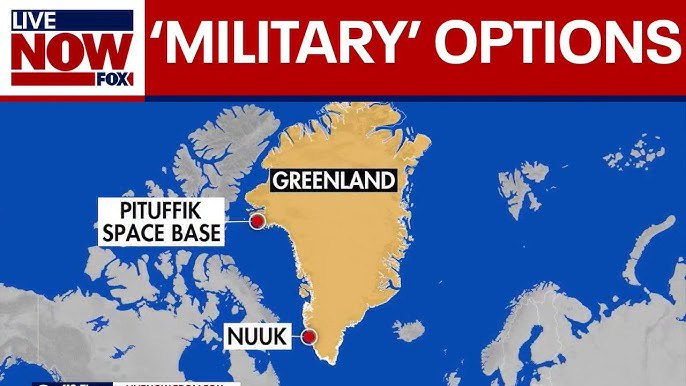
Within this logic, Greenland is a perfect target: militarily strategic, central to the Arctic, and crucial in the confrontation with Russia and China. And this must be stated clearly: the United States is already there.
At Pituffik (formerly Thule), in the north of the island, Washington maintains a permanent military base hosting missile early-warning systems, space surveillance, and key infrastructure for North American defense. This is not a symbolic presence of a few soldiers - it is a fully integrated asset at the core of U.S. strategic architecture.
Talking about “annexation” does not mean imagining a landing tomorrow morning, but rather a gradual process of hollowing out sovereignty until it becomes a mere legal formality.
Trump could pursue this through an apparently consensual arrangement - an economic offer, a special status, “enhanced protection.” Or he could do it the way power politics often works: through a fait accompli, expanding military and political presence until any opposition becomes impractical. In either case, the substance would be the same.
And this is where the real European problem emerges.
No country on the Old Continent appears willing to seriously oppose such a move -not for lack of arguments, but out of fear of the consequences: a NATO crisis, political retaliation, strategic isolation. The most likely outcome is one we have already seen too many times: statements of principle, some diplomatic protests, and then silence. Everything swallowed in order “not to make things worse,” just as happened when Washington suddenly imposed 15% tariffs without facing any retaliation.
If this were to happen, the implications would be enormous. For the first time, Europeans - the last U.S. allies still willing to defend Western double standards within the international order - would be forced to confront reality: a world in which rules apply only when they align with the interests of the strongest.
Europe accepted this madness in Gaza, just as it did during the U.S. invasions of the Middle East in the early 2000s. The kidnapping of Maduro is only the latest blatant example. We do not live in a rules-based order. We live under the law of force, disguised as legality. Historically, this behavior serves the powerful until they cease to be so - exactly what is happening to Europeans today.
And yet, this very scenario opens up a new political space.
Europe has a rare opportunity: to become the backbone of a global anti-imperialist network, capable of uniting countries that do not want to remain at the mercy of superpowers. And when I say Europe, I do not mean only the European Union - still slow and paralyzed by vetoes - but also individual European states or, for what matters, states from any other continent..
Take my birth country, Italy, as an example - but it could just as well be Brazil or South Africa, or any other medium-sized power. Italy is not marginal. On its own, it has a GDP larger than Russia’s (a striking reminder of how the entire European continent allows itself to be bullied by a country way poorer than the Union as a whole). It has longstanding relationships in Africa, the Middle East, and Latin America. A country like this could begin to weave alliances, build bridges, and propose an alternative - not to confront anyone head-on, but to reduce structural dependence on those who currently decide everything.
In practical terms, this would mean:
creating reciprocal economic and trade benefits for countries that join this network;
offering greater mobility to people, students, and workers from the Global South, finally abandoning the idiotic and suicidal anti-migration narrative - working with young, emerging societies is the only future for an aging continent;
building new military and security cooperation networks not subordinated to a single center of power, i.e. outside NATO control;
developing autonomous technological infrastructure, free from superpower monopolies.
This last point is not secondary. Today, much of the internet, cloud infrastructure, and essential digital services used in Europe (and beyond) depend on U.S. infrastructure, software, and companies: undersea cables, hyperscalers, operating systems, platforms. In a scenario of political coercion, Washington could quite literally “turn off the internet.” It would not even need to go that far - simply restricting access to critical services would be enough to paralyze entire European economic and administrative sectors.
Would there be sanctions, pressure, retaliation? Of course. But that is inevitable anyway. The choice is not between risk and safety; it is between paying a price now to build autonomy or paying a higher price later, under worse conditions, when alternatives will be even fewer.
Trying this path means working to prevent future conflicts - or, if they become inevitable, preparing the world that comes after.
Continuing to pretend that what benefits the powerful “won’t happen because it’s never been done before” is the true political irresponsibility of our time - especially on the part of those who govern us.
We must change course, before it is too late.
My name is Andrea Venzon. I am a political activist, and I write to help build an independent political space - free from the blackmail of great powers and from resignation. If you like what you read, subscribe. And if you can, become a paid subscriber: it is what allows me to keep writing, analyzing, and taking a stand without masters.