![Andrea Venzon [English]](https://substackcdn.com/image/fetch/$s_!_TTE!,w_120,h_120,c_fill,f_webp,q_auto:good,fl_progressive:steep/https%3A%2F%2Fsubstack-post-media.s3.amazonaws.com%2Fpublic%2Fimages%2Facd73441-dd62-4692-b623-54f4cf7c2bb7_1231x1231.png)
Beyond Ideology: A Transnational Movement for Liberation

Supporting those who are rising up in Iran today has brought back an experience I know all too well: being overwhelmed by insults, accusations, and delegitimization. “Zionist spy,” “CIA,” “agent of the West.” And much worse. This happens while thousands have already been killed and while an entire people is risking everything to free itself from a theocratic dictatorship that represses, tortures, and murders. It happens because too many people - especially in the West - have stopped looking at who is actually suffering and have started projecting their own ideologies and geopolitical obsessions onto the bodies of those in the streets, those being arrested, those risking their lives for freedom.
This is not a new experience. When I support Ukraine, I’m attacked by pro-Putin voices and anti-American ideologues; when I support Palestine, I suddenly become anti-Western, an extremist, a deranged communist. Today, in supporting the Iranian people, the pattern repeats almost identically. The contexts and words change, but the mechanism is always the same: instead of looking at oppressed people, one picks a geopolitical “team” and defends it - even at the cost of denying reality.
We live in an era in which imperialism and authoritarianism have violently returned to fashion, yet there is always a ready-made excuse not to stand with those on the front lines. Supporting Ukrainians fighting for their freedom is seen - by those who, sometimes rightly, distrust NATO and the United States - as a betrayal; supporting Palestine is perceived - by those who cannot tolerate anti-democratic armed movements like Hamas or theocratic regimes like Iran that back them - as a rejection of democracy; supporting those who rebel in Iran automatically becomes “playing the West’s game.” The result is that, in the name of ideological consistency, no one is supported anymore.
Meanwhile, reality keeps moving. People die, international law is trampled every day, and paralyzed by our “ifs” and “buts,” we leave millions at the mercy of local dictators and imperial powers. Today, more than 70% of the world’s population lives under authoritarian regimes; fewer than one in five people lives in a fully free country; more than 110 million human beings are displaced or refugees because of wars, repression, and persecution. This is the scale of the problem. Everything else is abstract debate.
There is also an uncomfortable truth many pretend not to understand. If those reading this article lived in Iran today, they would likely be very glad to receive external support - even from the United States - if it meant liberating their country. If they lived in Gaza, they would probably seriously consider joining an armed group rather than spending their entire lives under Israeli control. Not because it is abstractly right, but because oppression changes how people reason and drastically narrows the range of choices available.
The only way to truly understand whom to support - and why sometimes you have to hold your nose - is to stop observing the world from above and try to put yourself in the shoes of the oppressed. And this is precisely what is missing today: a transnational movement against imperialism and dictatorships that supports the liberation of peoples without asking them to pass an ideological purity test; that stands with people, not with power blocs.
Such a movement would not be abstract or symbolic. It would be concrete, visible, uncomfortable. It would organize synchronized protests in cities around the world every time a people is crushed in silence; permanent vigils in front of embassies and international institutions; targeted pressure campaigns against individuals and regimes responsible for repression; transparent fundraising to support activists, families of detainees, independent media, and tools of civil self-defense. It would be able to hold together the streets, legal advocacy, and communication - without delegating everything to governments that always arrive too late or not at all.
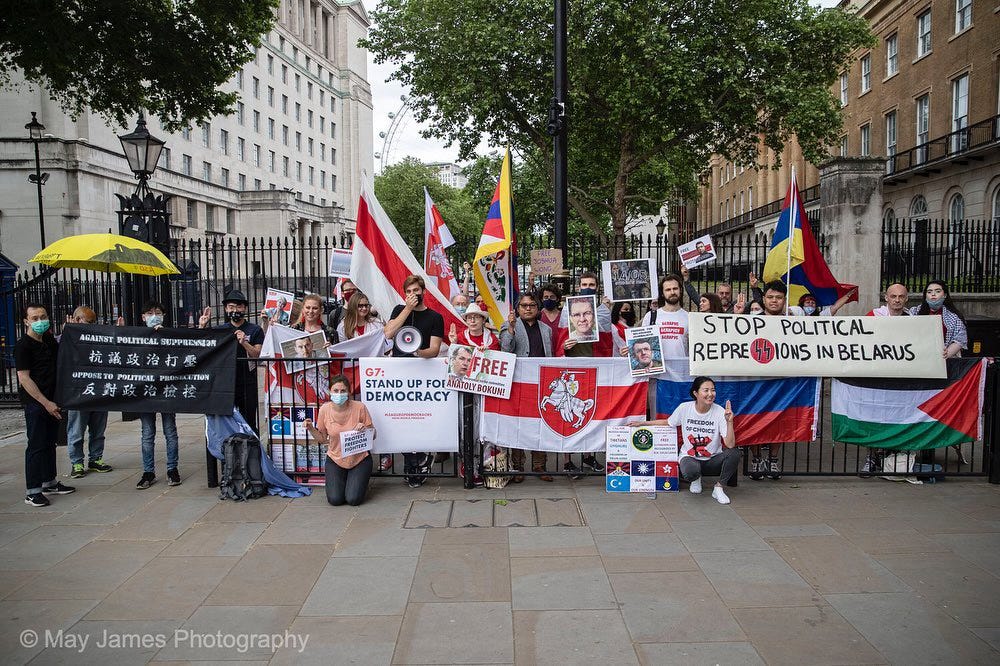
This is not a utopia. In embryonic form, we have already done it. In 2020 and 2021, together with Colombe Cahen-Salvador, we organized 50 consecutive weeks of protests called Fridays for Freedom, bringing thousands of people into the streets in cities around the world to support Hong Kong - breaking the silence and forcing media and institutions to look where they would have preferred to look away. Over time, those protests also drew in activists from other causes, from Belarus to Tibet, forming a true international front. Not only did we help many people in Hong Kong feel less abandoned; we can now also say that we have been investigated for terrorism by the Chinese dictatorship and are no longer able to enter the country. Obviously, these efforts did not stop the repression - but they demonstrated something essential: when solidarity becomes organized and transnational, it stops being a hashtag and becomes a political factor.
This is the level we need to return to - and surpass. Not choosing who is “pure enough” to deserve support, but who is oppressed enough to need it. Not waiting for the ideal victim, but acting in the real world, with all its contradictions.
Our duty is not to moralize about those who suffer, nor to judge their choices from a position of privilege. Our duty is to help them free themselves.
My name is Andrea Venzon. I am a political activist, and I write to help build an independent political space - free from the blackmail of great powers and from resignation. If you like what you read, subscribe. And if you can, become a paid subscriber: it’s what allows me to keep writing, analyzing, and taking positions without masters.